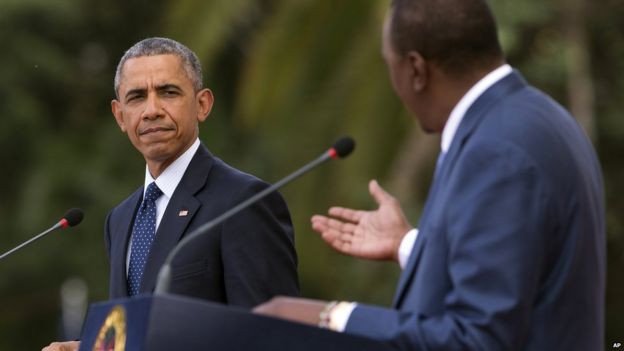
US President Barack Obama is concluding his visit to Kenya with a televised address at a sports stadium in the capital, Nairobi.
The BBC's Karen Allen in Nairobi says he is expected to underscore the shared values of the two countries but also touch on human rights.
On Saturday, President Obama discussed security issues with his Kenyan counterpart, Uhuru Kenyatta.
Later on Sunday, President Obama will fly on to Ethiopia.
The Kasarani stadium, where the US leader will make his speech, was last year used as a controversial detention camp for hundreds of Somalis during an operation against the Islamist group al-Shabab.
Our correspondent says Mr Obama is expected to warn that such tactics risk alienating communities and stoking radicalism.
On Saturday Mr Obama acknowledged the role the Kenyan government had played in the fight against militant groups such as al-Shabab.
The jihadist group has carried out a deadly campaign in Kenya including the 2013 attack on Nairobi's Westgate shopping centre and an attack in April in Garissa that killed nearly 150 people.
Security has been tight for Mr Obama's two-day visit to Kenya.
The trip, which began on Friday, is his first visit as president to the land where his father was born.
President Obama and President Kenyatta differed sharply on the issue of gay rights
In Ethiopia, he will be the first US president to visit the country. He will also become the first US leader to address the 54-member African Union (AU) on Tuesday.
AU Commission chief Nkosazana Dlamini-Zuma described the trip to Ethiopia as a "historic visit" that would "broaden and deepen the relationship between the AU and the US".
On Saturday, Mr Obama praised Africa's economic and business potential in a speech at a business summit.
He also visited a memorial for those killed in the 1998 US embassy bombing in Nairobi.
After holding bilateral talks, President Obama and President Kenyatta said they were "united against terrorism".
But they differed sharply in their positions on gay rights. While Mr Obama spoke strongly against discrimination, Mr Kenyatta said Kenya did not share the same values.
Ethiopian officials were not immediately available for comment
About 50 Ethiopian soldiers have allegedly crossed into Kenya where they took over a police station for several hours, a local Kenyan official said Tuesday.
“They entered Kenya in many army vehicles; they were all armed,” Ali Iyeese, an official in Kenya’s Marsabit County, told Anadolu Agency.
“They completely overran the police station in North Horr,” he said.
According to Iyeese, Ethiopian soldiers stayed for about two hours, surveying the area and taking photos.
The Illeret police station in Kenya’s North Horr Marsabit County is less than 20 kilometers from the Ethiopia border.
The Kenyan army, for its part, has remained tightlipped about the reported incursion, despite several attempts by Anadolu Agency to obtain comment.
Ethiopian officials, meanwhile, were not immediately available to comment on the allegation.
Eritrea denies barring President Uhuru Kenyatta's flight By Nyambega Gisesa Updated Thursday, April 30th 2015 at 09:18 GMT +3 Share this story: President Uhuru Kenyatta Eritrea has denied reports that it played a role in events leading to President Uhuru Kenyatta cutting short his trip to the United States midair last Thursday night. The Republic of Eritrea's Ambassador Beyene Russom said his country had given the Kenya government the requisite clearance for the President's jet to use its airspace on his way to Dubai, where he was scheduled to board a commercial flight to Los Angeles. "The Government of Kenya sought permission to use the Eritrean airspace and it was granted and all the relevant communication was forwarded to the Ministry of Foreign Affairs and aviation authorities," Russom told The Standard yesterday. But the envoy clarified that the President's Fokker 77 military aircraft never accessed Eritrean airspace. "They had the permission to fly through Eritrea. We gave all the necessary assistance to the Kenyan Ministry of Foreign Affairs and the aviation authorities," Russom explained. He was responding to reports that Eritrea ordered the Kenyan presidential jet to return after it was detected or risk being shot down because Kenyan media and politicians had linked the country with supporting Al Shabaab. Russom denied the claims of any dispute that could have prevented the presidential jet from accessing Eritrea airspace. He further added that media reports in Kenya of Eritrea providing safe stay and passage for Al Shabaab and other terrorists were not true and had no connection to Uhuru's flight. See also: Kenya is the best place to do business "There is a lot of misrepresentation being published in various sections of the media in Kenya. I am even being told that we chased away the presidential jet from our airspace because our country had been mentioned in connection to assisting the Al Shabaab. This is not true," he said. State House cited heightened military activity in Yemen for the return of President Kenyatta's jet last Thursday at 11.42p.m., about four hours after departure from Jomo Kenyatta International Airport. Russom said Eritrea had continued to offer support to Kenya in efforts to secure the country. "I am getting so many calls from other diplomats and friends from around the world who think that we apparently ordered the presidential jet out of our airspace in retaliation for the connection to Al Shabaab in local press," he said. The Eritrean government has since written to the Iran Embassy to seek a clarification on the same. The source of the information was said to be an Iranian diplomat. "They have denied providing any such information. We have further sent a complaint to the diplomatic community over the same," he added. In July 2012, the US government imposed sanctions on six people, including a senior military officer and the country's spy chief, Col Tewolde Habte Negash, over claims that they had provided weapons and financial support to Al Shabaab.
Kenyans lined up to view the bodies of those believed to have been the gunmen who killed nearly 150 people at Garissa University College in Kenya on Saturday.CreditBen Curtis/Associated Press
MANDERA, Kenya — Abdia Noor Abdi sat in the yard, exhausted after all the questions from the authorities. When she saw the face of her son on the front page of a daily newspaper, she pushed it aside and began to tear up.
He was not poor or marginalized, and did not seem especially angry. He strutted around in $200 suits, the son of a local chief.
Once a promising student himself, Mr. Abdullahi was killed along with the other gunmen as Kenyan forces stormed the campus in Garrisa. Police officers later paraded his naked, bullet-riddled body in the back of a pickup truck.
“He was a polite and obedient son,” his mother said. “We are in shock.”
But there were big mysteries in his life, his mother acknowledged. It was exactly one year ago, she said, that she last spoke to her son.
Mr. Abdullahi called her and said, “I’ll come home after evening prayers.”
By Matt Goldman on Publish DateFebruary 23, 2015. Photo by Ivan Lieman for The New York Times.
She never talked to him again, she said.
The Kenyan authorities are trying to piece together how Mr. Abdullahi, 26, went from the competitive University of Nairobi law school, where he impressed other students with his quick wit, to being the terrorist the authorities contend he was.
Though Kenya’s slums have long been fertile recruiting ground for alienated youth lured to fight for the Shabab with the promise of being paid, Mr. Abdullahi was educated, with a seemingly bright future.
His family said that after breaking contact, he simply disappeared. Kenyan authorities said Mr. Abdullahi was killed with the other gunmen after getting cornered in a blood-splattered dorm.
The Shabab, the Somali militant group that has attacked Kenya several times, has gleefully claimed responsibility for the attack, calling it retribution for Kenya’s military incursion into Somalia and vowing to make Kenya’s cities “run red with blood.”
On Monday, Kenyan defense officials said that their fighter jets had bombed two Shabab training camps in Somalia, the first military response to the university massacre, which was the worst terrorist attack in the country since the 1998 bombing of the United States Embassy here. Kenya’s president, Uhuru Kenyatta, had vowed to respond “in the severest way.”
It was difficult to assess the damage from the airstrikes, military officials said, because of heavy cloud cover. Kenya has carried out bombing raids in Somalia after terrorist assaults in the past, and the Shabab militants, knowing what was coming, have often abandoned their camps after major attacks.
Since 2012, more than 600 people have been killed in Kenya by the Shabab, an extremist group based in Somalia and affiliated with Al Qaeda. The group claimed responsibility for an April 2 attack on Garissa University College that killed 147 people.
Mandera
Wajir
KENYA
Attacks by the Shabab that resulted in one or more deaths
100 deaths
30
Garissa
5
Nairobi
In 2013, the Shabab mounted an attack on a Nairobi shopping mall that left at least 67 people dead.
Sources: Preliminary data from Global Terrorism Database, National Consortium for the Study of Terrorism and Responses to Terrorism; Armed Conflict Location and Event Data Project
Lamu
Mombasa
The Shabab issued a statement saying the bombs had missed and landed in an empty field.
Mr. Kenyatta was coming under intense pressure to do something. Many Kenyans are furious that it took more than eight hours after the attacks began for commandos to arrive at the university. The delay was attributed to logistical issues, but the slow response raised questions about whether more lives could have been saved.
Students at other universities have threatened to boycott unless security at their campuses is significantly improved. Others have complained that the Kenyan government had intelligence that such an attack was in the works and did little to prevent it.
Kenyan officials have talked of building a 424-mile wall along the Somali border, but it is not clear how that would help. As the portrait of Mr. Abdullahi put forward by the authorities shows, the problem of deadly extremism is now coming from within.
Mr. Abdullahi grew up in Mandera, a sun-soaked town where the borders of Kenya, Somalia and Ethiopia meet. A Kenyan of ethnic Somali background, he did so well in primary school that an uncle urged him to attend a high school in Nairobi, the capital.
“He was bright, hardworking and polite,” recalled Abdisalam Birik, a former colleague. “The last time I saw him was when he went to university.”
After university, Mr. Abdullahi worked at a bank and managed a small business on the side. Friends said he liked expensive clothing and loved to shoot pool. Photos of him show a thin, attractive man with a strong chin.
Publish DateApril 2, 2015. Photo by Dai Kurokawa/European Pressphoto Agency.
According to The Daily Nation, Kenya’s leading newspaper, Mr. Abdullahi wanted to join the Islamic State, but since he did not have a passport he settled on the Shabab (Kenya’s border with Somalia is notoriously porous).
His mother and six siblings said that he had never showed any interest in politics and that they had no idea what radicalized him.
“This was the first time we heard any news of him since he disappeared,” said Mr. Abdullahi’s older sister, Ifrah.
She remembers him as a helpful brother, a soccer fan and an avid reader.
“He liked ‘The Merchant of Venice,’ ” she said. “And those literature books.”
“I think someone brainwashed him to do something on behalf of them,” she said.
Another sister, Khadija, 16, appeared angry, sad and frustrated.
“He will not come back,” she said as she slammed her fist on a table.
The family house is on a dirt road, not far from the center of town. Mr. Abdullahi’s mother spent much of the day sitting on a bed in the yard, stunned.
Kenya can't, won't be Ethiopia By Mwaura Samora Updated Friday, April 10th 2015 at 00:00 GMT +3 Share this story: NAIROBI: The recent attack on Garissa University College, where more than 150 lives were cut short by Al-Shabaab bullets, has evoked anger among Kenyans. This and other bloody attacks in Mandera, Lamu and Nairobi have triggered numerous debates, drawing parallels between Kenya and Ethiopia in the war against terrorism. Despite Ethiopia having troops in Somalia, sharing a wide border with the lawless country and having a huge Somali population, there have been fewer if any attacks from the terror group in that country, or so the world has been led to believe. Although Ethiopia has been praised locally for beating an enemy that Kenya is apparently grappling to contain, the former's success against terror has been largely due to its history, system of government and unique internal dynamics. Unlike in Kenya where opinion on every issue is split between the two main coalitions, Ethiopia is a federal state ruled by a single dominant political party that practices a strict brand of socialism that places the state above everything else. The ruling Ethiopian People Revolutionary Democratic Front (EPRDF), which came to power in 1991 after a guerilla war against the bloody Mengistu Haille Mariam regime, holds total political sway. The coalition, which consists of four political parties, holds 499 out of the 547 national assembly seats. See also: North Eastern leaders, Knut donate Sh17m for terror victims To illustrate the country's political intolerance, the government often refers to the opposition in derogatory terms like "chauvinists", "narrow nationalists", "secessionists" or simply "enemies". The Ethiopian government controls all spheres of life, from media to people's daily lives. The main national broadcaster, Ethiopian Television, and most of the 10 radio stations, are owned by the government. Introduced in 1992 and giving the police sweeping powers to detain journalists without trial and shut down dissenting media outlets, Ethiopian media laws make the National Security (Amendment) Bill 2014 look like a legal walk in the park. After the 2005 general elections, many journalists were jailed and tens of protesters shot dead in the streets of Addis Ababa. Politically, the country is a federate divided into nine ethnically-based regions called kililochs, which the opposition has compared to the racially clustered apartheid South Africa's bantustans, each ruled by a party created or closely associated with EPRDF. And this is where, by default rather than design, the country's war against terror is won. Ruled by tribal councils which wield totalitarian powers, the Kililochs are divided into Kebeles, similar to wards, that comprise 3,500 to 4,000 people. Most Kebele members are armed and in charge of neighbourhood security, and so terror cells stands zero chance in these regions.